Learning4Resilience - Aufbau lokaler Lernzentren zur Katastrophenschutzbildung
Summer workshops on crisis preparedness and resilience in accommodation facilities in Berlin
Melanie Kinzel
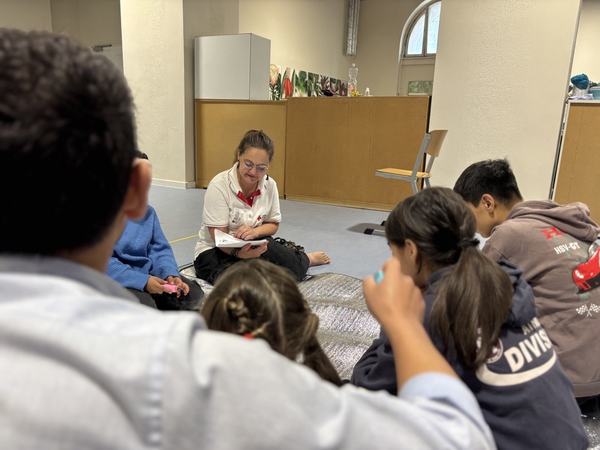
As part of the ‘Learning for Resilience’ project, we ran a series of workshops on crisis preparedness, disaster management and resilience during the summer holidays, in collaboration with the Berlin Regional Branch of the German Red Cross (DRK). The workshops took place once a week and were aimed at residents of the accommodation facilities run by the DRK Schöneberg-Wilmersdorf District Branch.
A total of 24 people took part in the workshops. The workshops were open to residents of all accommodation facilities run by the district branch. In addition to the residents, staff and carers also took part; drawing on their experience, they were able to provide important additional insights into the needs and challenges faced by the target group. This greatly enriched the discussions and the shared learning process.
The aim of the workshop series was to gain a better understanding of how people with experience of displacement and migration perceive various crises and disasters, what experiences they have already had, and what information is particularly relevant to their everyday lives in Germany.
The focus was on the various crisis and disaster scenarios that could also occur in Germany. Topics such as flooding, heavy rain, heatwaves, storms, fires and wildfires, pandemics, earthquakes and power cuts were discussed together. In addition, the participants looked at the warning and information systems in place in Germany, as well as how to respond appropriately to warning messages.
The workshops made it clear that many participants already have experience of crises and disasters from their countries of origin and therefore bring with them valuable knowledge and important perspectives. At the same time, it became apparent that the issue of disaster preparedness is often perceived as less relevant in Germany. Their new living environment is frequently experienced as comparatively safe, which means that potential risks seem less present in everyday life.
Another key finding was that knowledge of warning systems, emergency alerts and how to behave correctly in an emergency is often lacking. Yet it is precisely this information that forms an important basis for prevention, self-protection and resilience. The workshops demonstrated the importance of information and educational programmes tailored to specific target groups, which connect with the lived realities of people with refugee and migration backgrounds whilst also drawing on their existing experiences and skills.
The findings will now be incorporated into the further development of the education and training programmes within the ‘Learning for Resilience’ project. We would like to extend our sincere thanks to all participants and to the Berlin Regional Branch of the German Red Cross for the open dialogue and the valuable insights.
Ⓒ DRK Kreisverband Schöneberg-Wilmersdorf
.Stakeholder Meeting in Berlin
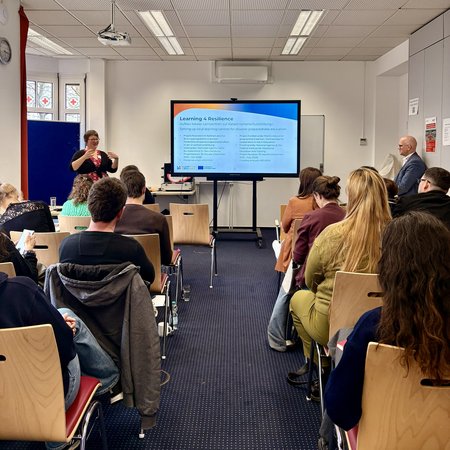
A meeting between the project partners and German stakeholders on 16 March 2026 provided new insights into the challenges faced by the target groups and highlighted ways in which these can be addressed. The focus was on the question of what obstacles hinder access to disaster risk reduction training for the target groups, whether through physical, linguistic or structural barriers, or unmet needs such as a lack of low-threshold provision. At the same time, discussions centred on how learning materials must be designed to be effective – for example, through simple language, accessible formats or practical content – and which existing materials or tools have proven their worth.
Ⓒ BGZ
.Another focus was on the pedagogical requirements that must be met to enable these groups to participate meaningfully in resilience training, such as adapted teaching methods, flexible logistics or clear learning objectives. Finally, the discussion centred on the key competencies trainers need to effectively reach these target groups – ranging from technical expertise such as first aid and digital tools to intercultural sensitivity and target-group-specific soft skills. The discussions provided valuable insights for developing tailored, inclusive solutions for effective disaster preparedness.
Transnational Project Meeting in Berlin
Our first transnational project meeting in Berlin on 16 and 17 March 2026 focused on translating plans into concrete actions: during in-depth discussions on disaster preparedness and resilience training, insights into research were shared, gaps were identified, and surveys for stakeholders and target groups were finalised. At the same time, the partners exchanged ideas on concepts for innovative learning spaces and discussed the foundations for training resilience trainers. By the end of the two days, the team not only had a clear roadmap for the coming months, but also a strengthened sense of collaboration and shared purpose.